Rently
A rental experience designed around trust between renters and owners.
- 6 weeksSolo sprintResearch to prototype
- 17Interview questionsFor renters and owners
- 2Rounds of usability studyLow and high fidelity
- 12Features in the value propositionUnder five user values
On this page
A renting site built on trust
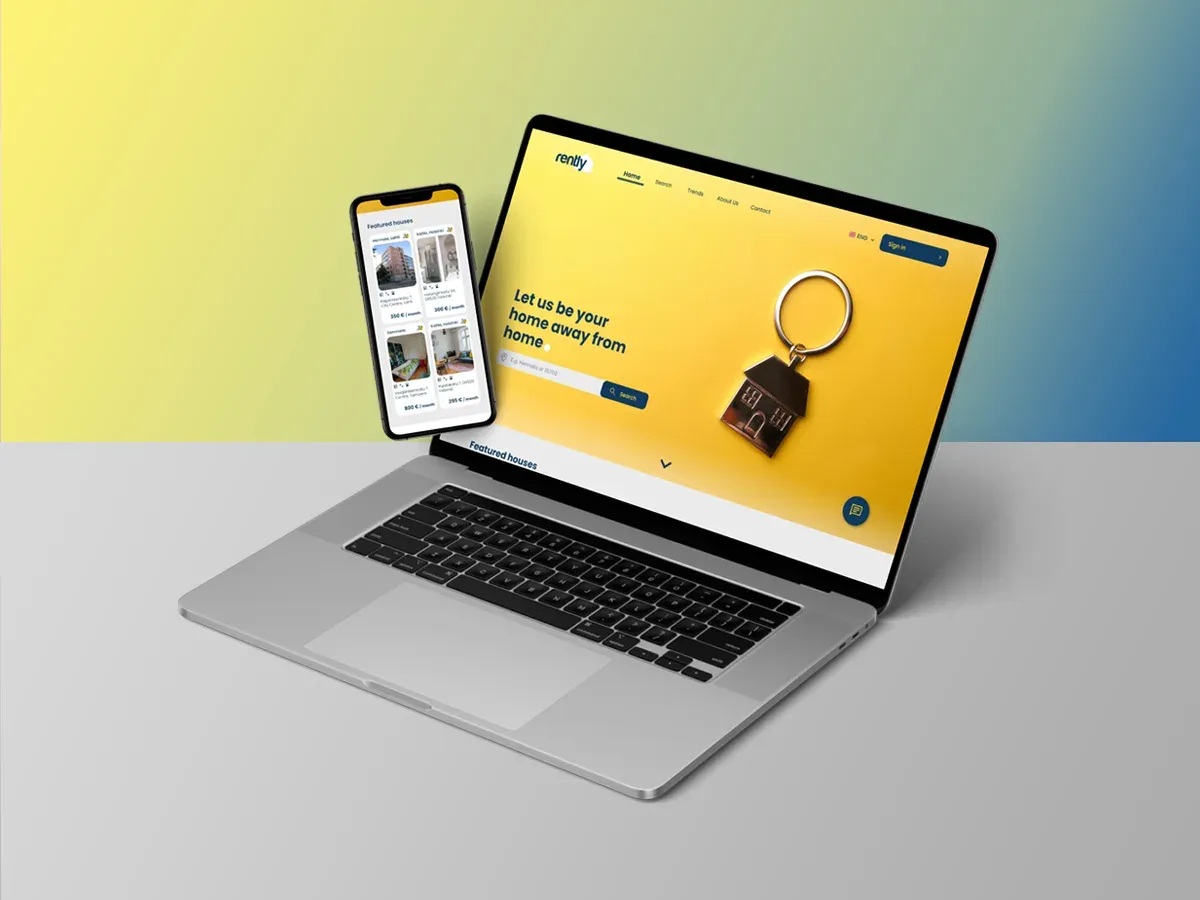
Rently is a responsive website for finding a rental home. It is built around trust between tenants and house owners: verified profiles, reliability scores, visit booking, application history, and help after the move.
I chose this brief, a scalable website for finding rental homes, because I have rented many places since my college days and found it hard to find a home each time.
I worked on it alone over a six-week sprint, starting with user research and a competitive analysis, then user flows, wireframes and prototypes. The goal was to ease the process of renting by building trust.
The problem
Paula is a recent graduate joining her first job. She needs recommendations for shared apartments to rent to save money, by booking visits and proving her tenancy to the house owner. As a newcomer to the city, she also needs guidance on insurance and moving help.
Her goal is to find a suitable apartment to rent, shared or alone, from a reliable house owner, by proving her eligibility.
What I set out to learn
Show the processResearch plan
I set six goals, the people to talk to, and seventeen questions for renters and for owners.
Interview goals
- Understand the common challenges people face in finding a rental home.
- Identify the frustrations people experience while renting.
- Understand where the knowledge behind choosing a rental home comes from.
- Understand the challenges before and after renting a home.
- Understand the common practice users go through when searching.
- Understand the difficulties of renting a house.
Who to talk to
- Ages 17 to 55, living in metropolitan or suburban areas.
- People finding their first rental home, people renting out their own home, and people who have rented before.
- People who move regularly.
- Different genders, people with disabilities, and people with different marital status.
What the interviews said
Show the processWhat the interviews said
The interviews were aggregated into one empathy map. Choose a part of it.
What people said
In their own words.
- “I’m not sure if the actual house looks the same as the pictures.”
- “I would like more details on available perks with the apartment.”
- “There is always a queue in renting, and the owner has the right to choose the tenants.”
- “I wish the tenant had some score so it is easier to convince the owners.”
- “I want to know if there is any possibility of sharing a rented apartment to save some money.”
- “Location, monthly price, apartment condition and equipment are the things I look for.”
What they think
What was on their mind while searching.
- Would like to be at the top of the tenant queue.
- Would like to know the equipment and location nearby.
- Wants to know about sharing options to save money.
- Would like cheaper options with low additional costs such as water.
- Wants a reliable house owner, to avoid unnecessary disturbance.
- Wants a notification when an apartment opens for renting in a specific area.
- Doesn’t know which area is best to live in, or how reliable and safe a neighbourhood is.
- Wants connections to family needs such as schools, shops and bus stops.
What they do
The situations the interviewees were in.
- Works a part-time job while studying.
- Works a full-time job as an engineer.
- Lives in a studio apartment near the city centre.
- Lives in a one-bedroom apartment outside the city, with a family.
How they feel
What the search felt like.
- Ashamed when another tenant is chosen over her.
- Mostly frustrated by the effort needed to convince the landlord of her eligibility.
- Delighted by additional facilities in the society, such as a gym.
- Sometimes lonely, and wants a roommate.
- Worried about limited space for the family, and about workspace when working from home.
- Worried about finding a newly rented apartment that fits her needs.
- Worried about upcoming renovations that might disturb the stay.
User stories
Show the processUser stories
Seven stories came out of the research.
- As a student, I want to rent a shared apartment, so that I can save some money.
- As someone new in the city, I want to rent in a safe area, so that I have peace of mind.
- As a young student, I must convince the owner of my eligibility, so that I am chosen as a tenant.
- As a family man, I want to rent a bigger apartment in the city centre, so that my family has enough space and access to daily needs.
- As a new tenant, I want a reliable landlord, so that I don’t face challenges in future.
- As an apartment owner, I want a reliable and trustworthy tenant, so that I have a regular income without extra hassle.
- As an active person, I want to know the facilities for activities in the society, so that I can stay active and follow my hobbies.
Five steps, repeated
Show the processDesign journey
Five steps from the brief to a tested prototype. Pick one to see what I did.
17interview questions, for renters and for owners
I planned interviews around how people find and choose a rental, what goes wrong before and after the move, and how owners choose tenants.
- Interviews
- Empathy map
7user stories, written from the research
The empathy map became a persona, Paula, with a user journey map from browsing for areas to agreeing a tenancy and moving, and a problem statement.
- User persona
- User stories
- User journey map
- Problem statement
12features in the value proposition
I brainstormed features and grouped them under five values: informative, cost and offers, accessible, reliable and after service. Then I mapped the information architecture.
- Value proposition
- Information architecture
- Paper wireframes
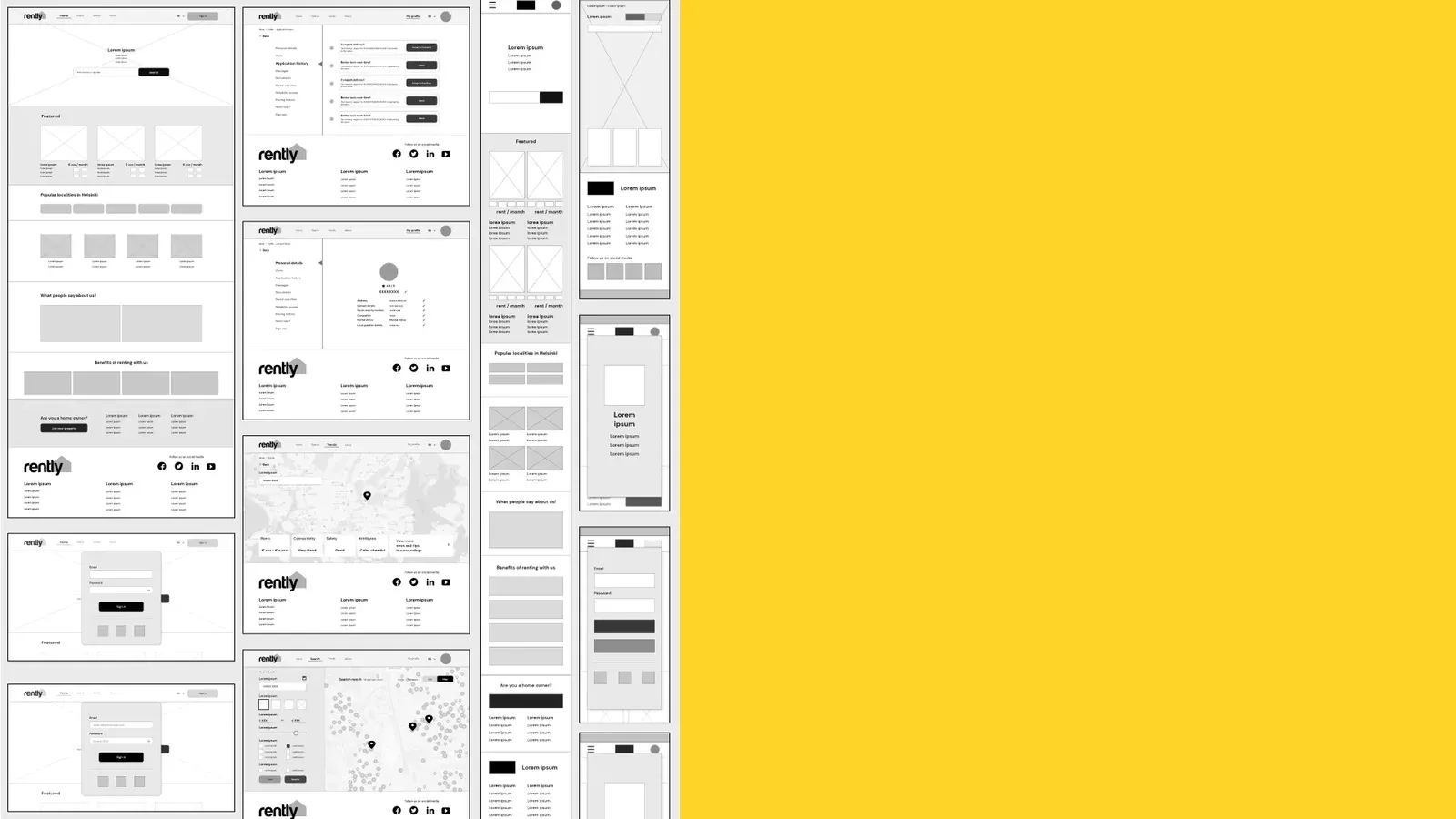
Digital wireframes and a low-fidelity prototype came first. After testing, I built the high-fidelity prototype.
- Digital wireframes
- Low-fidelity prototype
- High-fidelity prototype
2rounds of usability study, then a refine phase
The first round was on the low-fidelity prototype and the second on the high-fidelity one. Both were unmoderated and remote.
- Usability study
- Prioritised insights
- Refine
Value proposition
Show the processValue proposition
After understanding the users and redefining the problem, these twelve features made the value proposition.
- A single platform for notifications and searches for free homes to rent
- Separate paths for single renting, family renting and shared renting
- Verified accounts for tenants and house owners, to build trust
- Online documentation, to cut the time needed to verify reliability
- Online visit booking, to reduce calling and ease booking
- Information on trends in a city, such as rents, connectivity, safety and locality, for new arrivals
- Application history, so tenants can keep track of their applications
- Easy post-processing once a tenancy is accepted
- A history of tenants and reliability scores
- Helping owners find the most reliable tenancy options
- A one-stop solution for tenants, owners and house management, for worry-free renting
- Recommendations on house insurance and free moving help through the platform
Information architecture
Show the processInformation architecture
Six areas: Search, Area comparison, My applications, Profile, Log in or sign up, and For landlords.
Usability study
Both rounds were unmoderated and remote, so people could test and give feedback from their own place at a convenient time.
Research goal
- Determine the effectiveness and simplicity of completing different tasks on the house renting platform.
- Determine whether recommendations and review grading help users get more information about an area and find the right, reliable place to rent.
Participants
- Ages 18 to 55, living in metropolitan or suburban areas, in rented apartments and willing to find a new home to rent.
- Five males, five females, one nonbinary person and one physically challenged participant.
- One planning to rent a first house, one house owner who has rented out their place, and two who have rented apartments several times.
- The study was accessible with a screen reader and a switch device.
What the study showed
Insights were prioritised by their effect on the user journey and the time needed to build them. Priority runs from high to low.
In their words
Six things participants said while testing.
- “Is the house pet friendly, how shall I check that?”
- “I want to know the safest area to live in the new town, I’m always a bit afraid in the beginning.”
- “I assume that the owner, as well as tenants, have ratings so easy to choose the option.”
- “Can I save my search? I usually take time and ask others before going to see the apartment.”
- “It’s so good to get all help like insurance and moving to one place, now I don’t have to make Facebook posts.”
- “How can I ask the owner in case I have some more questions about the apartment?”
An efficient home screen
Users need understandable labels and ways to find important information such as searches, trends, profiles and communication between tenants and landowners.
Priority 1 of 5
User-centric search
Users need better customisation options in the search engine to incorporate their personal needs.
Priority 2 of 5
Booking and application to tenancy
Users need the flexibility to change a visit to check the house, and an easy way to make an application for tenancy.
Priority 3 of 5
Online documentation and verification
Users need the flexibility to store the documents needed for an application, and all profiles to be verified.
Priority 4 of 5
After-renting services
Users need easy access to related services such as house insurance and moving help.
Priority 5 of 5
Style guide
Show the processStyle guide
After two rounds of testing, refinements were made to make the user journey more thought through. The style guide fixes the logo, colours, type and icons. Press a colour to copy its value.
Typeface: Poppins, in bold, semi-bold and medium. Sizes are from the style guide, shown here in the site’s own type.
- Bold60 px
- Bold48 px
- Bold36 px
- Semi-bold24 px
- Semi-bold20 px
- Semi-bold16 px
- Medium24 px
- Medium20 px
- Medium16 px
Three decisions behind the site
The choices that shaped the site, and what each one costs. This is an independent case study.
Trust signals as the core idea
- What we chose
- Build around verified profiles, reliability scores, visit booking and application history.
- What it cost
- A score helps renters prove eligibility, and it raises the question of what goes into the score and who can see it.
- What followed
- Interviewees asked for it: "I wish the tenant had some score so it is easier to convince the owners."
Two rounds of usability testing
- What we chose
- Test the low-fidelity prototype first, then the high-fidelity one.
- What it cost
- Both rounds were unmoderated and remote, which is quick but cannot probe why someone hesitated.
- What followed
- Five prioritised insights fed the refine step.
One responsive site
- What we chose
- Design a single website that works on a laptop and on a phone.
- What it cost
- One system had to hold up on both screens.
What I took from it
What this taught me about the system
A reliability score is a judgment a system makes about a person.
- In a rental flow it can build trust, and it can lock people out.
- I would test what renters understand about their own score, and how they can challenge it, before it ships.
Product walkthrough
The high-fidelity prototype, from the home page to the tenancy application. Clips play the prototype. Press a screen to open it full size.
The full prototype
A walk through the high-fidelity prototype: the home page, search, a property with its tenancy application, application history and area trends.
Home
The home page leads with search, then featured houses, popular localities, reasons to trust the service, customer stories, and a section for owners who want to rent out their home.
The same page on a phone
The home page as a responsive layout on a phone, with the search field up front and the featured houses below.
Search that fits personal needs
Filters for type of house, rent, living area, rooms and the owner’s reliability, with tabs for shared, for you and for family, as a list or on a map.
Details and applying for a tenancy
A property page with its facts and similar houses nearby, and an Apply for tenancy panel with tenancy history, documents and a message to the owner.
Area trends
Trends compare an area before moving: the average rent, connectivity, safety and locality of a chosen neighbourhood.
Profile and applications
A profile with a reliability score, and an application history that shows where each application stands.