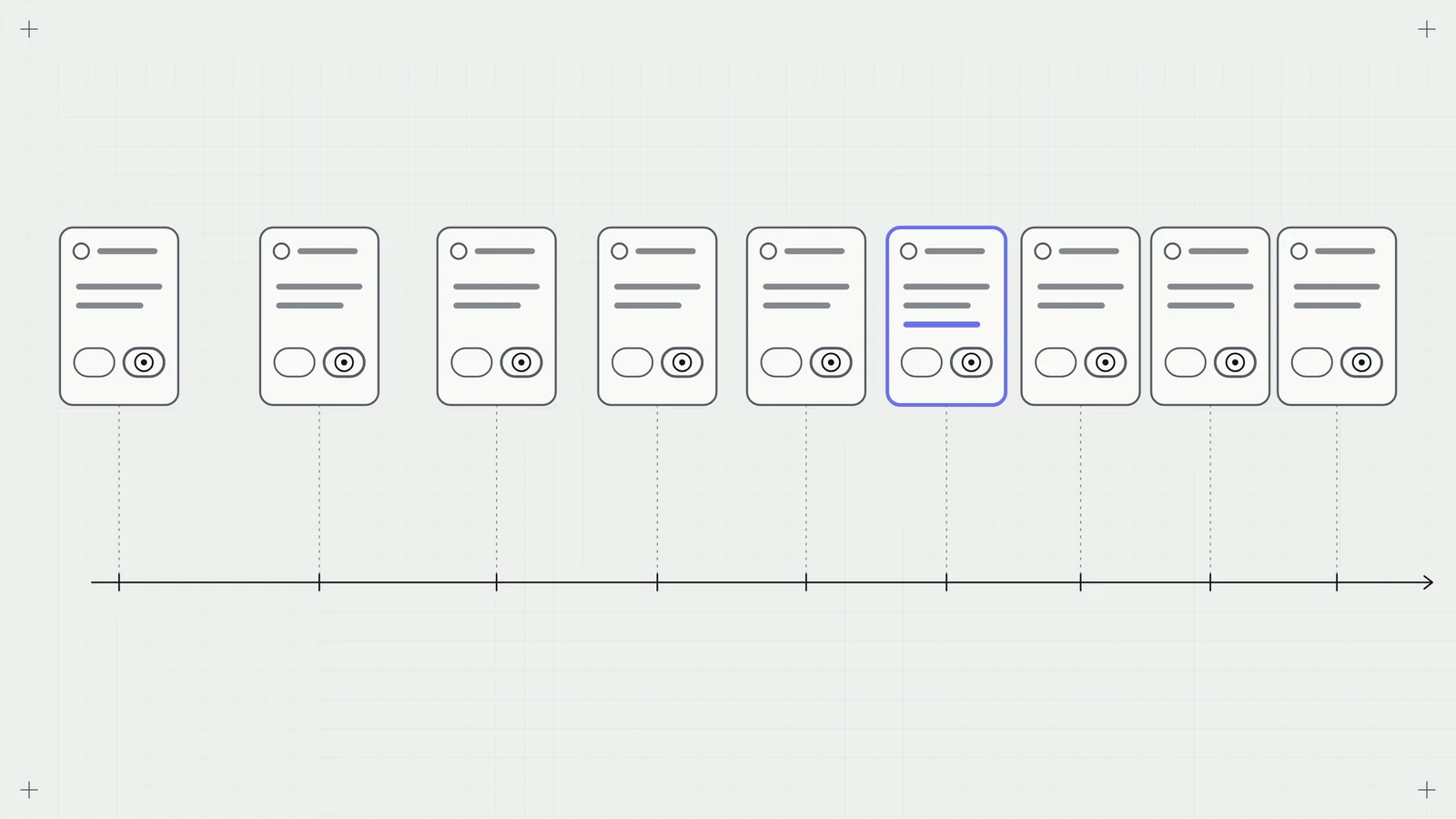
Every “Allow?” has two owners. A builder decided this action deserves an interruption, and a person answers it. The habit that forms between them, the rhythm of asking and tapping, has no owner at all.
That gap is what I want to look at: how the habit forms, how it seems to be forming now with agents, and who could own it. I build these prompts and I tap them, so I count myself on both sides.
A small moment
Last month I asked an agent to tidy a shared folder. The first few “Allow?” prompts I read properly. Around the fifteenth identical prompt I hit “always allow” to make it stop, and it felt like relief. Later I found it had moved a file a friend was still working in. Nothing was lost, but I couldn’t say which tap had let it happen.
How a tap becomes a habit
A prompt appears. You answer. Nothing bad happens. It appears again. My hypothesis (opinion): that loop is all a habit needs.
Think of a smoke alarm that goes off every time you cook. By week two you stop looking up, even though the alarm still works. (This is an analogy and I am not offering it as evidence.)
The evidence is older than agents:
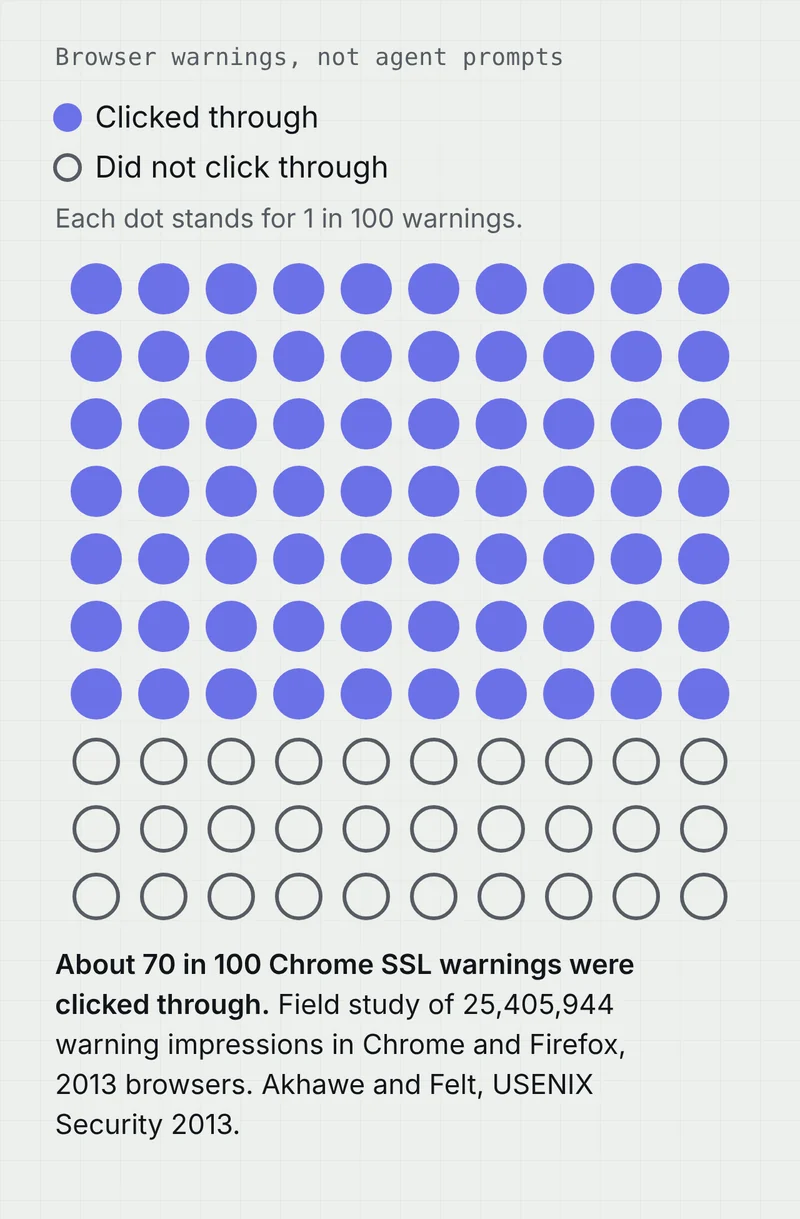
- Browser warnings: in a field study of 25,405,944 warning impressions in Chrome and Firefox, people clicked through 70.2% of Chrome’s SSL warnings (Akhawe and Felt, 2013).1 Chrome’s malware warnings did better at 23.2%, so the design clearly matters. These were 2013 browsers.
- Repetition: attention to security warnings declined with repetition, and varying how a warning looked slowed the decline (Vance et al., 2018).2 I could not see the sample sizes, so I only take a direction from it and no rate.
How it is forming now
I found no field data on how often people approve agent prompts in daily use, so this part is thinner than I’d like. The closest I found is a small simulated study. In the group that approved actions one at a time (34 of its 113 people), they approved 40.3% of the overreach actions they were asked about, 96 of 238 prompts (Yan, 2026, a single-author preprint with online participants and no real stakes).3
What I can point to is builders naming the habit themselves. Anthropic describes “approval fatigue, where people stop paying close attention to what they’re approving” (Anthropic, 2026).4 I read a builder naming the problem in public as a good sign.
In the products I looked at (Claude Code, VS Code, ChatGPT agent, Claude in Chrome, Windows Copilot Actions, MCP), the product mostly sets the default for when you are asked. You answer each prompt, and in some tools you can change the settings, but the finest controls sit in developer tools. That is my reading, not a count.
Who owns the habit
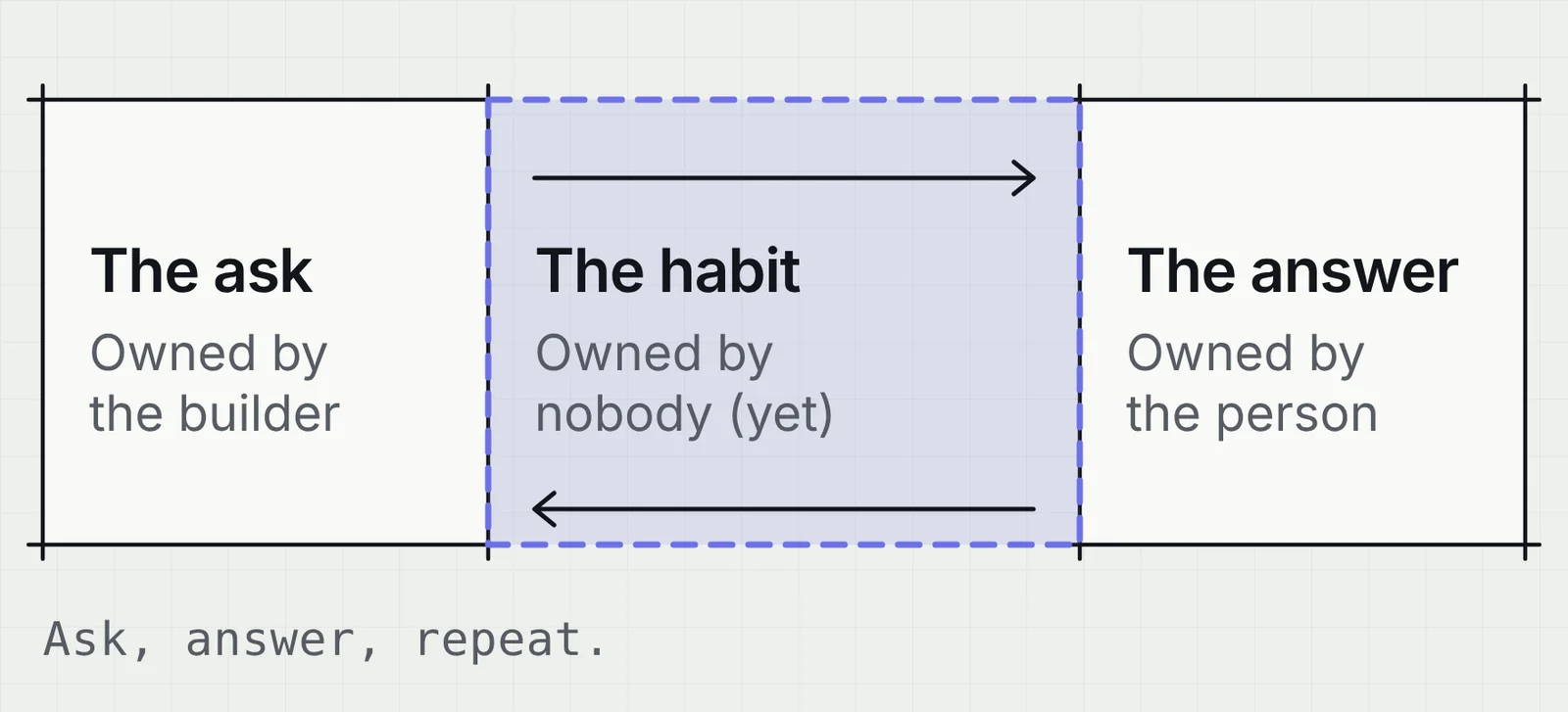
The builder owns the ask: when it appears, how it looks, what it says. The person owns the answer. Nobody owns the rhythm between them.
My hypothesis (opinion): the habit is a side effect of defaults, not a choice. And a habit nobody owns can’t be designed. Three lenses help me see it:
Problem space: interrupting is a trade-off between attention and visibility. Ask too often and attention drains. Ask too rarely and the person loses sight of what happened.
Product: what we measure shapes the habit. A high approval rate can look like trust on a dashboard. But in a review of 23 clinical studies, alert override rates ran from 46.2% to 96.2%, and 29.4% to 100% of those overrides were judged appropriate (Poly et al., 2020).5 The same number can hide habit, good judgement, or both. The rate alone can’t tell us which.
UX: what the person sees at the moment of the tap. In a study of 20 computer science students, 18 wanted a preview before an email was sent (Pochampally et al., preprint).6 Small sample, but it points at consequences, not steps. In a mining study of 290 public reports of agent file misuse, 31 involved approval prompts that showed commands, not their effects (Zhong et al., 2026).7
Try it
Eight made-up requests, one at a time. Tap whatever feels right, then see how your pace changed.
The tap test needs JavaScript, which is off or unavailable here. It shows eight made-up agent requests one at a time and times each answer in your browser, then compares your early and later answers. Nothing is stored or sent. It is a tiny illustration with invented prompts, not a measurement of anyone.
What we could do better
Plain ideas, each tied to a source or labelled as an idea. None has outcome data against per-step prompts.
For builders
- Show the consequence before the action (Pochampally et al., above).6
- Ask mainly near things that can’t be undone. In an Apple and CMU study (20 people, all recruited from one company), the authors write that participants “preferred to engage with the agent only at points that could have meaningful consequences” (Cheng et al., 2026).8
For people
- Decide what is worth interrupting you. Claude Code lets developers write allow, ask and deny rules by tool, command, path and domain,9 and VS Code approves per tool, command prefix, URL and folder.10 I found no figures on how many people change such settings. One small simulation found that standing rules cut prompts by about 40% but let more overreach through (Yan, 2026), so this needs testing.3
For both
- Make standing permissions scoped and revocable. The Chrome extension lets people grant or revoke access per website,11 and Microsoft says agent access on Windows “can be revoked at any time”.12
Two more ideas have no published source that I could find, so read them as ideas only. Ask budgets: cap the asks per session and spend them on the highest-consequence actions. Trust that grows with use: let a permission widen as someone keeps approving it.
How we could be wrong
Browser warnings and hospital alerts are not agent prompts. Here is what would change my mind:
| Belief | Test | We’d be wrong if… |
|---|---|---|
| Repeated agent asks build a tapping habit | Compare how often people catch a rare, important ask after many routine ones, versus after few | They catch it just as often |
| Showing the consequence beats asking per step | Same task, preview versus per-step prompts | No difference in caught mistakes or time |
| Nobody owns the habit | Check whether products show people their own approval patterns | Products already do, and people use it |
| Fewer, standing prompts help people | Compare caught overreach under per-action prompts and standing rules outside a simulation | Standing rules let more overreach through, as one small simulated study found (Yan, 2026)3 |
What I take from this
My take, as opinion, for each part of the work.
UX
Design the whole run of prompts. Show what will happen instead of the command, and make the rare important ask look different from the routine ones.
Design
Give consequence a visible look. An action that can’t be undone should not share a button style with renaming a file.
Product
A high approval rate tells you little about trust. Decide who owns the rhythm of asking, and test whether fewer prompts help before assuming they do, since one small study suggests they can let more through.
Back to the question
The ask belongs to the builder and the answer belongs to you. The habit sits in between, and so far it belongs to whoever notices it first.
So here is my question. Which of your taps this week were decisions, and which were habit?
Footnotes
-
Yan, 2026 (arxiv.org/abs/2608.27443). Preprint. 113 analysed participants (34 approving one action at a time), online, one scripted day, no real stakes. ↩ ↩2 ↩3
-
Anthropic, 2026 (anthropic.com). Quote only. ↩
-
Pochampally et al., preprint (arxiv.org/abs/2607.18257). Preprint. 20 students. ↩ ↩2
Eight made-up requests
An imaginary agent will ask permission eight times. Answer each as you would normally. Your timing stays in this page. Nothing is stored or sent.
Your tap test
This is a tiny illustration with invented prompts. It is not a measurement of you or anyone else, and it does not show how people behave. Timings were worked out in this page only and are gone when you restart or leave.
Made-up requests. Nothing is stored or sent.